
What would you do if you saw this on your school playground? Would you say, "Keep your hands to yourself!" ?


When we see this, we make sure to stand close and watch. These children are smiling, they are choosing to touch each other, to wrap their arms around each other and be rough. They are playing. It is a very natural kind of play that used to occur much more regularly in childhood when children were sent outside for the day to play with their friends. The adults were not there to tell them to "keep their hands to themselves", so rough housing was a regular occurrence. Nancy Carlson wrote a wonderful book on this type of play, Big Body Play: Why Boisterous, Vigorous, and Very
Physical Play Is Essential to Children’s Development and Learning. I encourage every parent and teacher to read this book. In this type of play children are honing their communication skills both verbal and non-verbal. They are also developing empathy and self regulation. It is also one on the main ways, especially for boys, that they express affection for each other. They get good at noticing when someone is upset and show incredible caring if someone gets a little hurt or bothered by the play.
Because these skills are developing and we do want to keep children in our care safe-as well as empower them- we do intervene. When we see this type of play developing, a teacher is always standing right by the children.

We have a designated place on our playground that we allow this kind of play. It is a wide open space free from structures. We teach the children where this space it at the beginning of the year and every time we see this kind of play somewhere else, we direct them to this spot. This works well inside, too, as when this big body play begins inside, as it always does, we can say, "hold on to that until you get to the safe place when we go outside." or "You can wrestle soon as we are going out right after this." We are valuing their desire to engage with one another, but teaching them how to regulate where and when it is okay.

We also teach them some tools for when they have had too much. They say "stop" or "time out" and that is the signal for everyone to release. That child who needed the break walks away or stands still or sits and when he is ready, says, "time in!" and the play resumes.

We talk about some actions that are not okay. Grabbing heads, faces and hoods is off limits. In the above picture, an adult stepped in and reminded the boy in the red pants that grabbing heads isn't alright.

We are there to check in as well with questions if we see facial expressions that seems less than happy, "do you want to play this way?" " do you want them both to be wrestling with you?" "do you need a break?" Then we help them vocalize their needs to their friends.


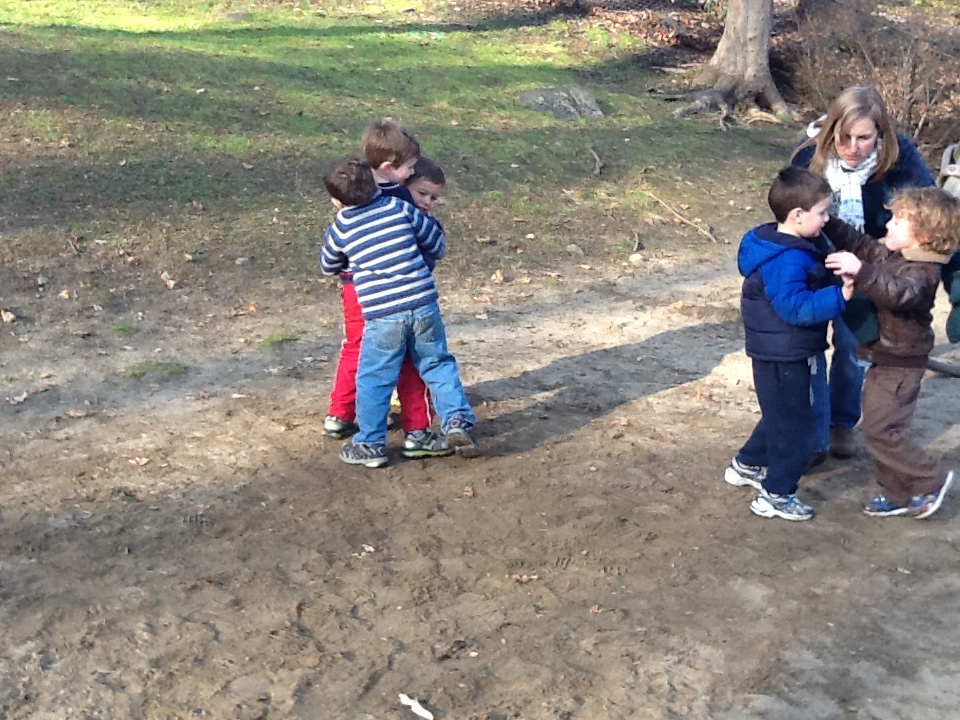
We are constantly present to help them be aware of their surroundings. These boys on the right were getting too close to a structure. We stop them, help them to notice this potential danger and then supervise their good choice to move.


Sometimes it happens naturally when two or more children happen to be in this spot and they start wrestling. Other times one child will "shop" around for a friend and we will hear him, "want to go wrestle?" One time two boys were shopping for one friend who wanted to take both of them on in a two against one match. They had trouble understanding why no one would agree to this, but they were very persistent and made a game out of their search.

And, its not just for the boys! We have had several girls over the years who actively engage in this kind of play. Another aspect we discuss with them is being aware of their individual strength levels. It is amazing... a child of four can learn to regulate the amount of force used on various friends based on their reactions.


We are not "hands off" teachers letting the children engage in dangerous activities. Instead we are very actively involved in saying, "yes" to these children learning social cues, self regulation, empathy and expressing their emotions while engaged physically.


