Sunday, February 10, 2013

Spicky Ball Painting


I am a big fan of dollar stores.  I was in one the other day and saw these cool spiky rubber balls at the check out counter.  I immediately thought that they would be fun to paint with so despite the fact that they did light up and make a noise when bounced...I took a risk.  


We cut paper to put in trays we had.  We filled low dishes with various colors of tempera paint and put a ball in each color.


The children wrote their names on the paper and then flipped it over to paint.  They chose a ball, rolled it around in the paint and then put it on the tray.


Then they angled the tray in various directions to paint with the balls.  


Of course, some of them discovered the fun of painting with more than one ball at a time.;-)
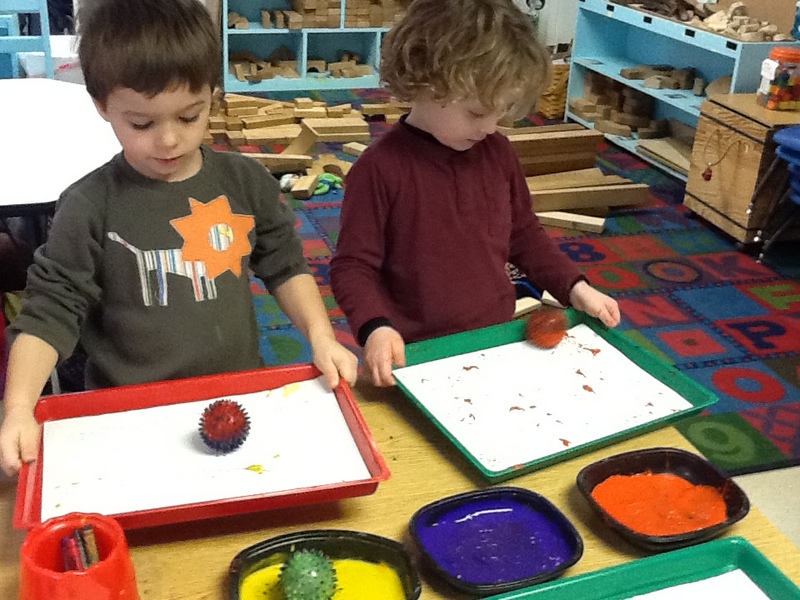


As they rolled and painted, they noticed the dotted patterns the balls made and how the colors overlapped and sometimes mixed.


They experimented with directionality as they tried to control the ball and get it  to move to the white parts of the paper


The paintings gave way to a great deal of discussion of the various kinds of marks the balls made on the paper from splots to dots to swishes.  The activity was out all week allowing children to return to it again and again to try out new methods and repeat their initial discoveries in order to build upon the experience. 

And...it wasn't until the very last day, that a few children noticed the noise and lights that the balls could produce.  Very little attention was paid to this as the act of painting captured their interest even more.  

One note: sometimes the balls do roll off the trays, so make sure to do this activity above a washable surface such as tile or linoleum.  Our table is near a carpet, so we covered that edge of the carpet with a drip cloth while the activity was taking place.    


Saturday, February 9, 2013

Keep Calm and Play On: Thoughts from Suzanna of Pop-Up Adventure Play

CCNS will be hosting Marc Armitage on March 20, 2013 at the Rowaton Community Center. Here is a guest post from the organizer of the event, Suzanna, explaining her connection with his work. Ticket sales are limited, so reserve your spot today!

When I first started working with children, I was barely an adult myself. At 16, I was met with a room full of tiny people all looking at me with expectant little faces. I was just a teenager, in a voluntary role, and the only thing I knew how to do was to have fun. So that’s what we did.

It was only around 5 years later did I realise that my first day looking after children was very significant. Though I was placed in a teaching and supervisory role, I never insisted that children followed my instructions precisely. I allowed creativity, exploration, green elephants and flying monkeys. And I never felt like I was teaching, but I had no other word for what I did. I allowed children to take the lead in our lessons together and tailored all the teaching materials according to their needs and wants. On that first day of teaching I had decided that I wasn’t a teacher.

And then one wonderful day when I came across the word “Playwork”.

It turns out, all those years, unbeknown to myself, I had been practicing playwork. I didn’t know that I was doing it, but upon reading the googled websites, I realised that I was wholeheartedly agreeing with the guidelines for being a playworker. I accepted a job at an afterschool club where I would be working as a playworker, but very soon I realised that the organisation that I was with wasn’t necessary working with the child’s best interests in mind. My role was a childminder at best, with a generous portion of parent and teacher roles on the side. I wasn’t working as a playworker, but I knew I wanted to be, so I left the job and went on a quest to find out more.

I am fortunate that after leaving that job I was able to find an actual playworking job in an organisation that had a passion for play. They trained me, and mentored me to become the playworker I am today, but for a long time I was very confused. I have always wished that someone could have come along to tell me the specifics of playwork, and explain to me just why play was important to children and why my role as a playworker had a significant impact in the world. I had to find out the hard way that there are like minded people out there who see children for who they are, and not just as a future adult. I look back and wish that I didn’t need to struggle through the first few years of my career, carving a path into a play when there was already an existing and vibrant crowd of professionals who are always ready to spread their wisdom on playwork, and their experiences in the field.

Ladies and Gentlemen, you are very lucky. You have an expert in play coming to you. You have Marc Armitage coming to your local area to talk about the importance of play and playwork, and not only that, he is a wonderful playworker, really fun to hang out with, and a joy to work with. If someone like him had come to me, right at the beginning, I would have been the first one there, on the front row, lapping in their every word. But this doesn’t happen all the time, and it definitely can’t get much better. Ladies and Gentlemen, I present to you Marc Armitage on his Keep Calm and Play On tour. Don’t miss out on it.

For more information about Marc Armitage’s Keep Calm and Play On tour, please visit 
http://popupadventureplay.blogspot.co.uk/p/keep-calm-and-play-on.html. More thoughts and information from Suzanna, please email suzanna@popupadventureplay.org.

Monday, January 28, 2013

Drip Painting with Wooden Spoons-Emergent Curriculum in the Twos

My wonderful guest blogger, Lini, teacher of the twos class at CCNS is back sharing a wonderful experience she had in her classroom last week.  It is so important to watch how the children interact with materials to help you create positive learning environments for them and to be able to expand their experiences. Lini is gifted at noticing the sparks of engagement in her students and taking them to the next level.  


Last week one of the girls in my 2s class was painting at the easel when a blob of blue paint accidentally hit the floor. I watched her surprise as it splattered on the floor, and then as she intentionally shook the brush to make more blue drips on the floor. 

"No!" I called to stop her and asked her to help me clean up the floor. Thinking of her excitement at watching the paint drip and that at CCNS we are all about finding a way to say "yes", I stifled my knee-jerk reaction and instead covered the floor with newspaper put her paper on the floor and told her now she could drip the paint.
Two other children seeing what she was doing joined in. 

As I planned my activities for the following week, I thought about this girl's exploration of dripping paint and decided to make it the painting activity for the week. I had to move some tables and cover some shelving to protect from paint splatters. I didn't want to use paint brushes that might encourage painting rather than dripping, after a little experimentation I settled on wooden spoons in tall plastic cups of paint.


One parent told me that on the way to school that morning her daughter told her "I want to paint on the floor today". She hadn't gotten a chance to try it last week, but remembered it over the weekend. 

I started with individual drip paintings, then as a variation used a large sheet of paper to make a communal painting together. I used this activity in both of my classes, but noticed that there was more excitement about it in the class that initiated the activity. 


It really made me appreciate how much more involved children are in activities when we follow their lead and let their interests guide our planning.