Sunday, January 27, 2013

Problem Solving with Melted Crayons


In a previous post I wrote about our experiment of removing the markers from class following a presentation by an occupational therapist.  This has been going really well and the children never ask for markers.  The OT did mention making sure the crayons are sharpened from time to time, so we made sure to have fat crayon sharpeners available.  My assistant had been really great at remembering to sharpen the crayons and several children became quite interested in the process.  They enjoyed sharpening the crayons.  Once we taught them to save the shavings, we ended up with a nice big collection of colorful shavings.

Then, the question was what to do with them.  At the same time we had been having a little problem with our meeting area.  The Winter sun shines very bright right where the children look at messages, graphs, books, etc. in our meeting area.  We do not have blinds on the windows, so we needed to come up with a way to block the sun a bit.  We had already moved our furniture around to try and angle our easel the other way, and it wasn't enough.

While thinking of a creative way to block some sun, we thought about using our crayon shavings and this is what we came up with...

Fold a piece of black construction paper in half.
Draw two white dots on the folded edge near the sides of the paper.
Have the children make a line from  one dot to the next; wavy, rainbow, zig zag, and then cut it out.


Open the paper to reveal a frame.
Take a sheet of wax paper.
Sprinkle the crayon shavings on one half of the paper.


Fold the other half over the crayon pieces.
Cover with a thin towel and a piece of paper.


Run a hot iron over the towel while counting to 20.


Check on the melting of the crayons.


Re-iron until desired effects are achieved.


Tape the wax paper to the back of the frame.
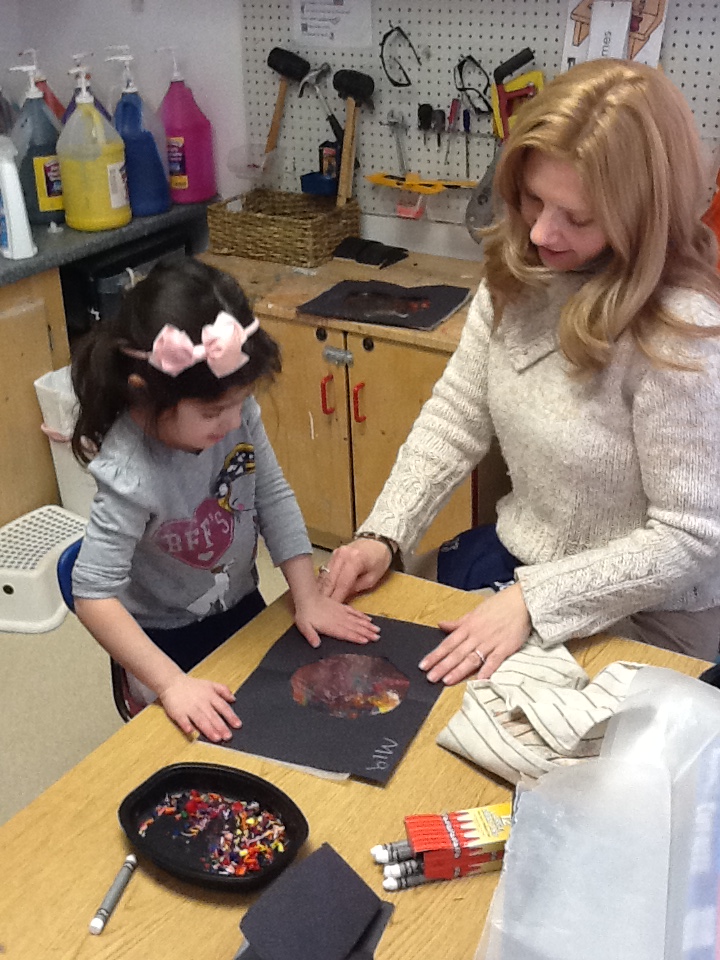


I had the children put one hand behind their backs to help prevent them from having a hand near the hot iron.  The other hand I placed on the handle and ironed with them.  The ironing part of the activity was done on a one-one basis, so this activity does require more teacher involvement than most of the art we do.  It was fun to make predictions and talk about what we noticed happening to the crayon shavings.  The colors mixed, some wax spilled out, it was warm, and much more.  I always love when science and art blend together so well.

And the bonus was.... this fun process, actually looks stunning AND solved our sun problem.


So sharpen your crayons and give it a try!

Tuesday, January 22, 2013

Musical Experts Visit the Classroom


Today we had four musicians visit our classroom.  The most wonderful part about it was that they were all alumni of our school, CCNS.  They were able to come back to the classroom where they spent their four year old year to share their musical expertise with other students.  


I'm proud to say two of them were my own children. I am the proud mom of the baritone horn player, 


and the saxophone player.  


We also had a percussionist who plays in an orchestra, band and a  jazz ensemble.  He showed us his marimba, several drums and an incredible mallet set.  


Our last expert played the cello, bass guitar and French horn.  During their visit each musician told us a little about their various instruments and answered the questions that the class had come up in expectation of their visit. 

On the list were questions such as what is an amp?
What is a percussionist?
How much does your instrument cost?
What is that thing you pull across the strings?
What is a reed?

They had formed these questions based on some of our reading and in talking about what our experts would be bringing to show us.  

The musicians each played scales so we could hear the sound of each instrument.  Then each of them played Twinkle, Twinkle Little Star so we had a familiar frame of reference to compare how different the tones were when each played.  Finally they put their playing together to get an incredible version of this well know piece.  


Then the musicians stayed during our open play time so the children could get up close to each instrument, touch it and try it out by pressing keys, valves, moving a bow across strings or pounding some mallets.  


The children also remembered our conducting lesson from a few weeks ago and asked the musicians to let them conduct as they played.  Our experts were terrific sports with this playing faster or slower based on how my students waved their "batons".


They knew my daughter was in a marching band based on the memory I shared while doing our memory drawing last week, so they asked her to teach them how to march.  She showed them the different foot positions for forward, backwards and sideways marching and they had a little parade.  


Before the musicians had to leave, our researchers did some sketching of the different instruments around the room.  


It was an incredible day of in depth musical instrument research as we sought out answers to our wonderings by consulting an expert, doing field sketches, and playing!!

If you need experts to help you with your next project.  Seek out some alumni members of your program.  They are usually more than happy to help, love to visit their beloved school and are fantastic with the children.  

This blog post is dedicated to these four special CCNS alum who learned early just how important it is to 
PLAY!!!!  Thank you. 

Monday, January 14, 2013

Scientific Painting- It Does Not Diminish Creativity


 Our amaryllis bulb that we planted early last month finally bloomed! It has three different flowers on it right now; one that is past its prime, one that is fresh and fully open, and one that is still budding.  There is an incredible amount to observe about this plant.  It is also several shades of green and red.  Therefore this week we are painting pictures of it.


Before painting we talked about what we noticed about the plant and what colors we would need if were to try and paint a picture of what it really looks like.  We use the term scientific painting and also tell them that it is also called Still Life painting.  


The children were given palates of the colors they said they noticed: red, green, brown, yellow and then some white as well.  They each had a water cup to rinse, several brushes and a paper towel to dry off their brushes in between colors.


We also cut large paper into a long strips to allow them the room to focus on the height feature of the plant.  


As they began painting they started to notice the different shades of the colors on the plant and began mixing the colors on their palates.  When a child discovered a new color, she would excitedly shout out the directions to her table mates.  "I made pink!  I made pink! I put some white in the red and it makes pink! "

As we talked about what they noticed about the plants, I posed the question of how to make darker shades of some of the colors and they began to experiment with this.


When a child completed a painting we held it up against the plant for inspection.  We asked them if they were happy with their painting the way it was? The first time I showed this girl above her painting she said, "oh, I forgot the bud, I need to add that."


This boy looked at his painting and the plant for a bit and said, "yep! I like it."  This is another way to encourage the children to be critics of their own work and not rely on adults to praise them.  Our comments reflected more of what we noticed.  "I see you mixed a darker shade of red for this flower, tell me about that."  "You used a different shade of green for the pot than the stem." "Tell me about these white lines." (one child painted the stamens of the flower)


Creative, free idea art is a staple in our classroom as regular readers of this blog know very well.  However, there is a place for the skill of recording our observations about our environment.  We need to expose children to this activity as well.  We did not teach them how to paint this flower.  We encouraged them to really look at it and to use the medium of paint to represent it.  It became a multi-faceted lesson on observation, color mixing, and looking at their work with a critical eye.