Saturday, December 15, 2012

Happily Playing or Actually Listening


My heart goes out to the families and friends of all of the victims of the tragedy that happened just 45 minutes away from my own school and the schools of my children.

I know many experts are now speaking on the news programs and on line about how to talk to young children about this horrific event.  What I'd like to address is what not to do.

Yesterday as parents were showing up for dismissal, many of them started to speak about the trajedy, thinking their own four year olds were busy on the playground and therefore could not hear them.
Today, as I did my grocery shopping, I saw several moms with young children in those car shaped carts, stopped next to each other.  The mothers were discussing the events and various bits of information that they had gathered from the news.  I'm sure in many homes the news has been on non stop while children are playing in the same room as the television.

I am writing to implore you to think about what these young children are hearing.  They may look like they are happily playing and oblivious to what you are saying, but they can hear you.  They are hearing sentences that include "in a school", "young children dead", "he shot the teacher", etc.  They may not stop playing, they may not even ask you questions, but what they are hearing can be incredibly scary to them.

I know this horrible event is on our minds and we, as adults, need to process this by talking to friends and commiserating with each other.  Please pause, however, and think of your young ones.  Can they hear you?

Tuesday, December 11, 2012

Crayons vs Markers-Please respond


I am curious to gather some opinions here.

We recently had a wonderful professional development session given by occupational therapist Melody Cohen who is based in New Canaan, CT.  She was sharing with us information about hand development and proper grip development with young children.

I could write several blog posts about what she explained to us, but the item I found most interesting was her emphatic plea to get rid of markers and even pencils in our preschool classrooms.  She believes very strongly in the use of crayons.  She implored us to get rid of the markers around the rooms.  At the time of her presentation, in my classroom, I had crayons and markers, as well as colored pencils and fat graphite pencils, but the children usually choose the markers. In fact, I could not remember seeing the children ever choose the crayons from the writing buckets all around the classroom.

Melody explained to us that with markers it is very easy to produce a mark on a paper.  You can hold the marker at just about any angle with varying amounts of pressure and it still works.  With a crayon, you need to use more pressure and varying amounts of pressure when writing and coloring. Crayon use is also more conducive to proper grip development as they are shorter, often lighter, have marks on them with which to align fingers and you need that control of pressure that only a thumb and forefinger working together can achieve.

So I did an experiment.  I removed all of the markers from my classroom aside from those used on the various whiteboards around the room.  I was ready for the children to balk the next day, to search for the markers, to complain that they were missing.
It has been over a month now.  Not a single child has mentioned the missing markers.  They are all happily using the crayons.

And...I can see the few children that used to write with their elbows in the air and with such a light touch starting to gravitate their arms and hands closer to the paper.  It has been an interesting experiment that I am planning on continuing while I process this, observe more and research it more myself.  I am really interested to hear from other teachers.

What do you use and WHY?    

Monday, December 10, 2012

More or Less Bags-At Home or School


I have a collection of these wonderful draw string bags that a parent made for the school once. I'm sure it would be pretty easy to find little bags that are not see-through with all the gift wrap available in stores these days.   I filled them with a collection of two different objects in each bag.  Examples of what I put in the bags for this activity include:

buttons and popsicle sticks
feathers and caps
crayons and pencils
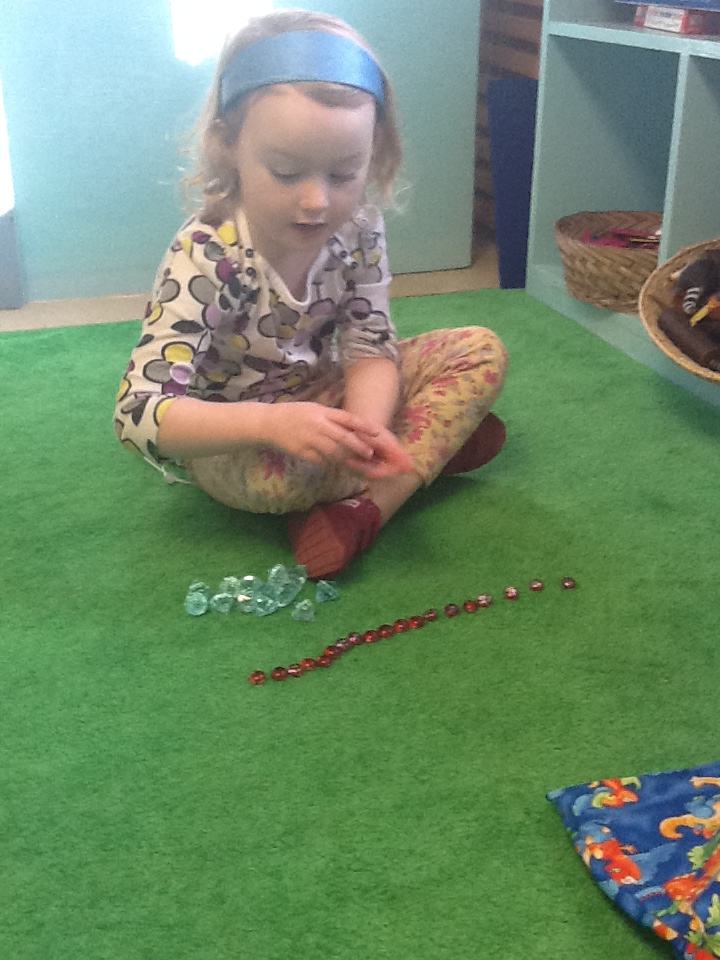
blue gems and red gems
lady bugs and butterflies, and so on.

The children were told that these were mystery bags for a game of more or less.  They were going to figure out which item had more.  


 The children took a bag and sorted the objects in to two groups.  First they predicted which group they thought has more and then counted each group. Estimation is a critical skill in mathematical development and our young children can be challenged to predict at an early age.  "What do you notice?"    "Before you even count, which one do YOU think has more?"  "Let's estimate before we count."  If you get the proverbial, "I don't know", just tell them to "give it a try" or "take a guess."


The children were encouraged to line up the objects in order to see the one-one correspondence of the materials as well as showing them how to move objects over as they counted to help avoid counting an item more then once.


I varied the number of objects in each bag from 8-20 objects.  Some bags even had the same number of each item.


Sometimes the larger in size item had fewer than the smaller in size items, so they looked longer when spread in a row.  This often challenged the thinking of the children as many of them thought the longer the row, the more objects there were.  Some of them had to count several times to convince themselves.  


We played with these more or less bags in small groups allowing me to differentiate the learning experience for the children based on the guidance I gave or the questions I asked.  I was able to scaffold the learning experience to meet them each at their level of expertise at counting and challenge them to the next on an individual basis.  


The bags are now on a shelf in our classroom and the children can independently access them to explore bags they didn't get to count or to play the game along with friends.  They really enjoyed the mystery of not knowing the items and the challenge of discovering which had more.

This is a fun game that can even be played at home with various objects around the house.  Compare spoons and forks, lego pieces and match box cars, blocks and magnets, socks and clothespins....what can you come up with?