Do you remember the first time you had to cook an entire meal?
Following recipes, getting timing right for each part to be ready at the
same time, and trying to present it in an appetizing way?
I know from experience that doing this, even now, especially for a
large holiday meal, has my kitchen ending up somewhat of a disaster zone.
Like my mother (who is an amazing cook) I have every cabinet open and am
probably covered in flour or splatter from the stove. With experience, of
course, this has become much easier and I am much better at cleaning up as I
go.
Now imagine cooking that big meal for the first time and being
told not to make a mess and to not get dirty. How would that feel?
Can you imagine the added pressure of trying something new and learning
to explore the nuisances of a recipe without spilling a little flour or having
a cracked egg drip on the counter? I know I would feel a lot of pressure and
would not enjoy myself very much. To me a big part of cooking is tasting
and trying new things, making mistakes and learning from them.
So why am I talking about cooking here? This does relate to
the classroom. I quoted my favorite saying in my last post about the babyand the puddle, "a dirty kid is a happy kid!" But why is that?
A child who is free to explore her surroundings with wild abandon
is joyful. Children put their whole selves in an activity if they are
allowed to do so. Young children paint with various brushes, yes, but
they use their whole arm and their hands as part of the process. Often
the brushes are cast aside in order to feel the paint.

Children that can explore materials in this way will make amazing
discoveries of how the material changes and responds to various uses.
This free exploration allows them to foster their creativity and make
sense of the material. After this open ended discovery children are more
receptive to using it in certain ways when the time comes, such as using paint
or clay or glue for a project as they get older.

One of our main goals for young children is to expose them to as
many different materials as we can and to give them the time to freely explore
them.

Now go back to that cooking example and imagine a child trying to
explore foam paint right after being told that she cannot get dirty. That
child will feel quite a bit of pressure and anxiety. She might stick a
finger in the paint or a stick, but she will not smear is all around her paper
and test how many little embellishments she can get to stick in the paint, or
how fluffy she can keep it on the paper, or how it smoothes out the more she
presses on it and stays fluffier with a gentle touch.
She will not be the child wiggling in her seat with pure joy or
the one so excited that she needs to stand up and use her whole upper body as
she paints. But, she will be clean.

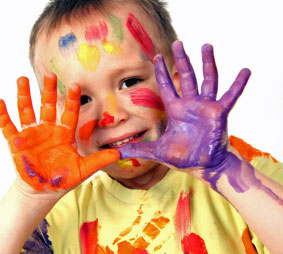
The joyful child will be dirty. She will have paint on her
sleeves or her shoulders (like me today) or in her hair (like me yesterday).
Back a few years ago-(ok, several years ago) my children came to
our little red school house, and when I picked them up covered in paint or mud
or glue, I knew they were fully engaged in exploring and were going to have
amazing discoveries to share with me.

I clung to that excitement when late at night; I'd be tossing
these clothes in the laundry with a bunch of stain fighters and hoping they'd
get clean. But if not, no worries. I knew within moments of being
back in school, those stains would be recovered by the evidence of the new
days' exploration.