Wednesday, February 27, 2013

Making Instruments-Our Project Continues


Our study of musical instruments has been going really well.  We had some wonderful visitors to class demonstrating their instruments for us. We've also gone on two field trips; one to the local middle school to interact with their band and then to the High School to see their wind ensemble.  On both trips the children were able to use the instruments as well as ask about them and photograph them.   Some of the non-fiction books we have in our classroom show how to make several different instruments.  The children selected a few that they wanted to try and make.  I spent an evening combing Home Depot and the dollar stores and here is what we made.


Using wood blocks we gathered from scraps and metal kick plates, the children made xylophones.  The mallets were made using a pencil, nail hammered into the top and wrapped with duct tape.  


The wood pieces have an indentation in the middle of them to allow the metal to vibrate.  For the wood without this indentation we had to put something under the metal plates.  We experimented with other pencils, small wood pieces and toothpicks.  The small wood pieces worked the best.  


For the horns, I purchased a garden hose and cut it into pieces along with several funnels of various sizes.  This and a roll of duct tape were all we needed.  The children were able to insert the funnels, secure them with duct tape, decide how they want the horn to wrap and secure this with duct tape as well. 


The tricky part came when learning how to blow.  You have to blow like a real horn with pursed lips.  It takes practice.  When my daughter Jessie visited she showed them all how to blow.  Many of them remembered and after several days of trying, they were able to get it. Now into our second week of playing them, they are getting really good at producing different sounds.  They enjoy playing for each other.  We keep them in the classroom where they have access to them.  They can get the horns independently and play them during our long activity time.  Most days the horn players walk around with their horns wrapped over an arm while they play.  


A couple of children chose to make a flute.  We used bamboo and drilled holes into the pieces.  We haven't had much success with the flutes, but they enjoyed the process of making them.

The children also embellished their instruments by painting them with liquid water colors or colorful making tape on the horns.


There certainly is a lot of joyful noise in our classroom these days!


A New Perspective-Under Table Drawing


To give a new perspective to drawing in class, we taped a large piece of rolled paper onto the underside of the table.  We placed pillows under the table and buckets of different writing materials each day; markers, silkies, rainbow crayons.


The children used big arm movements to draw.  It was a collaborative effort as they laid down in groups often having to figure out how to fit in to the rather small space. We are always encouraging problem solving!! They paper was there all week and they were able to go under and draw anytime during our activity time.  


One boy took one of the mirrors we had out for a block building activity and used it under the table to look at the drawing and then to look at others around him. He then taught his friends how to do this.  


Give this under the table drawing a try.  We may be fostering the next Michelangelo!

Tuesday, February 26, 2013

A Problem Solving Challenge In the Preschool Class


Posing a question for children to try and answer by planning and testing their ideas fosters creativity and problem solving.   It also creates a wonderful environment for team building.  

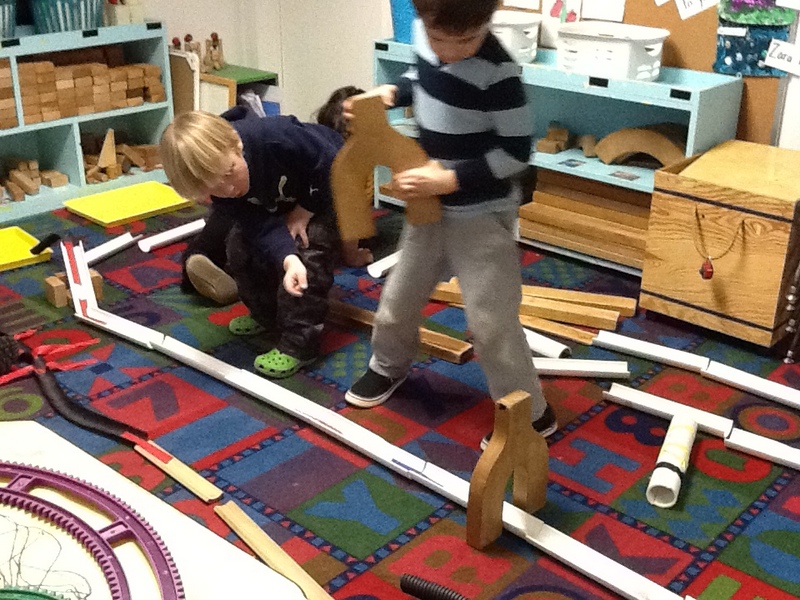
The challenge proposed here was "How can you move the balls from one tray to the next without touching the carpet?"  The trays were placed on each side of a large rectangular carpet.  We added cove molding, PVC piping cut in half, our regular blocks, some flexible tubing, ping pong balls and masking tape.  


Some children tried to build up much like a bridge and had to deal with support issues.


Others made long paths and had to figure out how to keep them from moving and separating.


Others built paths with sides to prevent the balls from rolling out.


As children returned to this activity each day during the week, the ideas became more elaborate as they built on the trials and errors of past days and implemented ideas seen tried by others around them.  


They even started to record their ideas on the clipboards that are always kept in the block area.  


Later in the week, we added wiffle balls and golf balls to see if these would react differently in their paths.

This inspired children who do not usually play in the block area to give it a try.  New combinations of children played together as they shared their ideas and worked on a common goal.  


How do you promote problem solving in your classroom?  Have you tried giving your students a challenge along with some open ended materials and time to try and try again? I would love to hear about it.  Tell me your ideas in the comments or link your own blog posts here as well.