Just read an article in the New York Times about parents being upset with the amount of artwork that they have to deal with from their children. I find this a very sad state of affairs and am so grateful anytime a self created piece of work comes home from my children now that they are in elementary, middle and high school.
In the comment section, there was a great suggestion for storing artwork. Find it on the ohdeedoh website.
I do not save everything my children create. I do save pieces that they are particularly proud of, or that show a developmental milestone. I try and involve them in the process of choosing. I also take photographs of their projects if they are particularly meaningful. This works well with dioramas and clay pieces. The other way we deal with this issue, or I should sadly say, dealt with, is to give them to relatives. We turn them into presents, cards and gift wrap when possible.
And remember, the biggest focus should always be on the process. "Did you enjoy making that?" "Tell me how you made that?" "What made you think of that?"
As I look at my kitchen bulletin board full of tests and essays, I am longing to have this problem back.
Thursday, January 27, 2011


Learning Through Play in a Bear Cave
One of the most important components of the project approach/emergent curriculum with young children is dramatic play. As explained in a great book I have been reading, Young Investigators-The Project Approach in the Early Years, “young investigators often show what they know through their play. …As children represent roles using the props, they show the depth of their knowledge of the topic as well as their understanding of the roles of adults (or animals in our case) regarding the topic. …The teacher can extend the opportunity for children to show what they know by participating in the play group. In this way, objects can be requested by name, and the teacher can give specific items to children to see how they are used and to take note of the vocabulary they have already mastered.”
This week we put this in place by creating a bear cave in our classroom.
On Monday the children helped us remove our regular props of dress up clothes, food, dishes and babies. We then took large cardboard boxes, cut them apart and laid them over the furniture securely attaching them with duct tape. The children helped with all the kinds of tape they could find around the room.


We talked about the size of the entrance to the cave and decided to cut it out in the front. Then we had to do some problem solving as the scissors were not working.
We ended up using one of the saws from our workbench.

Then we made some rocks for the front of the cave. This became quite the effort in team work as children crunched paper and tried to tape the rock balls with masking tape.
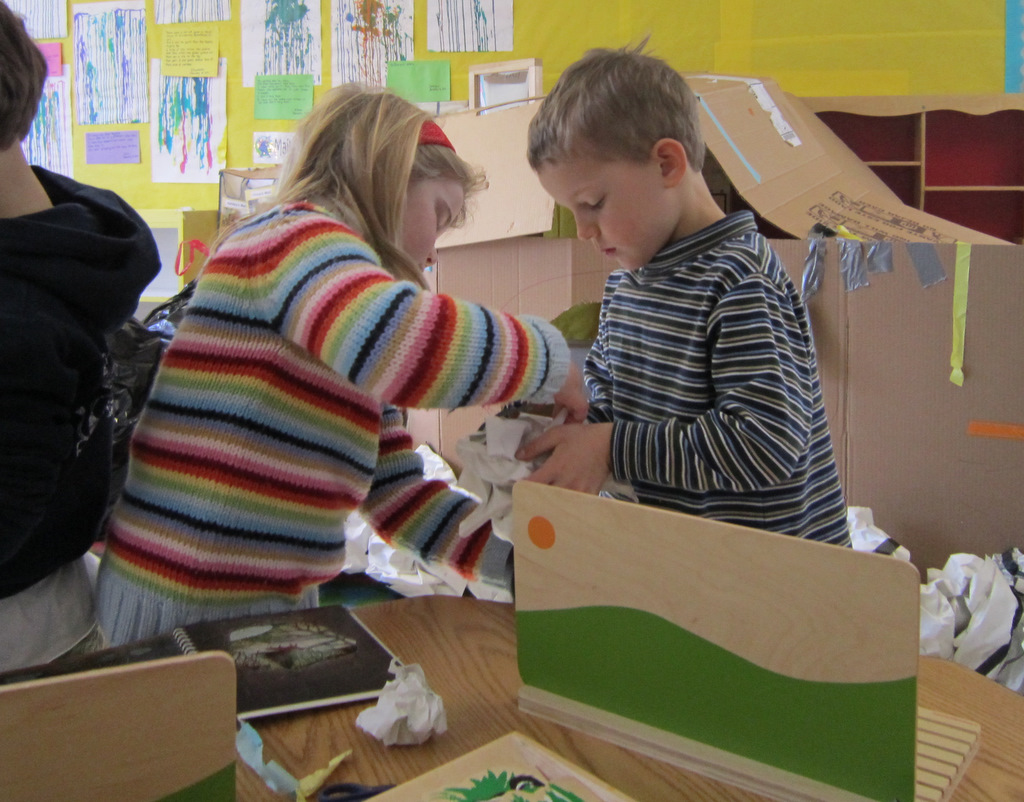

Some children did some research to find out how bears create the insides of their caves. We made some grass by ripping green paper to line the inside of the cave.

The next day we painted the outside of the cave and added more bedding. This time we added sticks and twigs (paper towel rolls), animal hair (raffia) and leaves.


Of course we had test it out along the way.
A great deal of problem solving is occurring while these bear cubs vie for personal space.

Once in the cave, they decided they needed food. We went back to the books to research what the bears store in their caves (if anything) and found out that they will keep a stash of nuts and berries if they can. A few cubs went off to make food.

When we were finished, I joined in the play as Momma Bear. We read about how the bears snuggle up to keep warm, so that is just what we did. It was a lovely, quiet time inside the cave talking about bears.
When it was time to clean up for the day, I realized that one of my little bear cubs had actually fallen asleep on my lap. Now that is how you study hibernation!

Monday, January 24, 2011
Learning Through Snow Play

We are experiencing a wondrous winter here in Connecticut. We actually have snow-and lots of it. It is easy to send our children outside to play in the snow. Children of all ages, from preschoolers to teens, will happily spend hours engaged in such play.
But is there value in having kids play in the snow other than the benefits of fresh air and time away from the TV? Absolutely! An in-depth look at what children are learning gives greater value to the experience.
Snow play requires creativity, scientific observation and negotiation skills. Think of the creativity fostered as children build snow creatures and use various objects to decorate them. They learn the complexities of problem solving as they try to mold snow into different designs. Adventurous types learn about construction and the properties of physics as they try to build jumps for sledding or walls for snow forts.
When friends play together, they learn social skills needed for negotiation as they develop the rules for snowball fights or come to understand how to take turns while sledding. Kids learn self-control while they wait for their chance to fly down the hill, or hide out for the perfect shot. These are not rules that are taught to them from a skill book or basketball practice; they are spontaneously created by the group, and are likely to be internalized on a much deeper level than through books, parents and teachers.
This is play in its organic form; experimenting, discovering, problem solving, negotiating, and creating all wrapped up with the emotion of joy.
This is the play that will give them the skills needed to be successful adults.
Harvard professors Erika Christakis and Nicholas Christakis say something similar. In a recent article on CNN.com, “Want to get your kids into college? Let them play”, they write “one of the best predictors of school success is the ability to control impulses. Children who can control their impulse to be the center of the universe, and—relatedly—who can assume the perspective of another person, are better equipped to learn.” They continue to explain that “through play, children learn to take turns, delay gratification, negotiate conflicts, solve problems, share goals, acquire flexibility and live with disappointment. … Academic achievement in college requires readiness skills that transcend mere book learning. It requires the ability to engage actively with people and ideas. In short, it requires a deep connection with the world.”
In the overly scheduled scramble of daily living that is the current norm, it is easy to be lulled into thinking that we give our children plenty of play opportunities. Our children are on sports teams and in dance classes and have every electronic gadget advertised on TV—complete with “educational” games. However, this is not the play that will develop these particular social and problem solving skills.
When a child is on a baseball team, she is learning a finite set of rules and skills. Yes, this is an important kind of learning. Nonetheless, when there is a situation on the field, the umpire and coach are responsible for deciding how it will be handled.
Conversely, in a snowball fight, the children develop the rules and consequences as the play evolves through negotiation and trial and error.
A recent article in the New York Times, “Effort to Restore Children’s Play Gains Momentum” by Hilary Stout, describes the impetus for many parents and professionals to get behind the play movement. “Much of the movement has focused on the educational value of play, and efforts to restore recess and unstructured playtime to early childhood and elementary curriculums. But advocates are now starting to reach out to parents, recognizing that for the movement to succeed, parental attitudes must evolve as well-starting with the willingness to tolerate a little more unpredictability in children’s schedules and a little less structure at home.”
It can be quite difficult. As I try and write this, my children, ages nine, twelve and fourteen, are home and stuck inside due to an ice storm. It would be so much easier, not to mention neater, if I would allow them to sit in front of the television rather than pull out all of the art materials that I did. It would be even easier for me to put a stop to the fact that my son has created a catapult using kitchen utensils and is investigating how far his clay creations can sore through the kitchen, but I keep reminding myself of the incredible learning that is taking place.
As parents, we need to embrace spontaneous moments of creative play. Not only that, we need to create the time and space for them to occur, which may require putting aside routines and our comfort levels for noise and mess. While doing so may not be easy, it is well worth it for the powerful message we tacitly send to our children as to the value of this type of activity.
Still, I sure do wish my son could go play in the snow right now.
A shorter version of this post appeared in TheDailyNorwalk.
Subscribe to:
Posts (Atom)